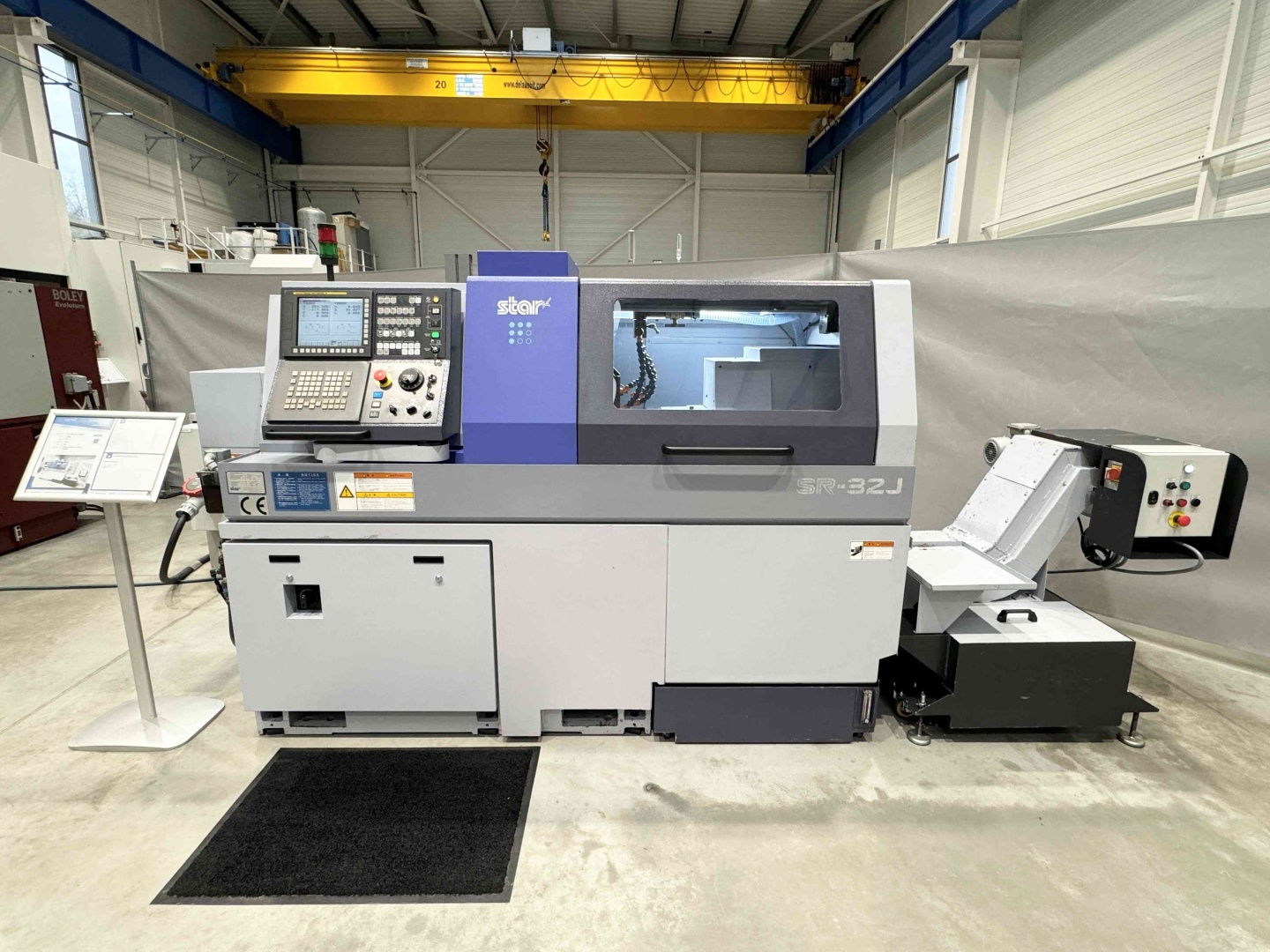












How to choose the right CNC lathe with a sliding headstock for your industry?
Each industrial sector has its own specific requirements, which must be taken into account when choosing a CNC lathe with a sliding headstock. Here are a few tips to help you select the most suitable model for your field of application.
High precision and reliability for the medical industry and implantable devices
The medical sector requires a lathe that offers very high precision and excellent process reliability. Applications in the medical industry often require tolerances of less than 5 µm on implants or instruments, as well as flawless traceability. This requires a machine capable of maintaining this precision over long production runs without drift.
Multi-axis (7 axes and more) models with options such as the B axis (for complex shapes) are useful for producing, for example, implant screws with special threads or curved surfaces. Also ensure that the machine provides a flawless surface finish and reduces roughness, which promotes infection, an essential criterion in implantology. Certain operations specific to the medical industry, such as thread whirling for manufacturing deep-threaded bone screws, are available as options on Swiss lathes – this may be a deciding factor.
Finally, the thermal stability of the machine is important because long production runs in clean rooms must not cause dimensional drift with temperature.
In short, for medical applications, the focus is on precision, repeatability and the ability to machine difficult materials (titanium, stainless steels) with a high level of cleanliness. Models with a 20 mm bar capacity (e.g. the SR-20 from STAR, the Citizen L20 or the Tornos DECO 20) are very popular in this sector.
Spindle power for the aerospace and defence industries
While precision is just as important as in the medical industry, machining power is paramount in the aerospace and defence industries. This sensitive sector is particularly interested in the machine's ability to machine resistant materials such as aerospace stainless steel, Inconel, titanium and hardened steels, while maintaining good productivity. It is therefore important to consider the spindle power and rigidity of the machine.
A model equipped with powerful spindle motors and tools (e.g. 5 kW on the main spindle and 2–3 kW on the motorised tools) will be able to handle the demanding machining of these materials without excessively slowing down the feed rates.
Turning centres for the aerospace industry must also be capable of complex machining operations (angled drilling, pockets, etc.), so machines with multiple axes and a large tool capacity are preferable. For example, manufacturing an aerospace connector made of hard alloy, with four radial holes and an internal hexagon, will require at least seven axes and good synchronisation of the C rotations.
Also consider cooling and filtration systems: prolonged machining of hard metals generates heat and abrasive chips. A machine that is well equipped with high-pressure cooling and chip removal will be a plus.
In summary, for the aerospace and military industries: choose a robust, powerful, multi-axis machine and check the availability of lubricant and chip management options (high-pressure cooling, conveyor, etc.) to ensure stable machining of tough materials.
Endurance and productivity for the automotive industry and high-volume bar turning
The automotive sector values production speed and reliability 24/7. If you produce automotive parts in very large quantities (e.g. sensor contacts, studs, valve pins), consider a fast and durable machine.
The criteria for choosing a CNC sliding head lathe for the automotive industry are:
- speed of execution with minimal vibration at high speeds,
- the number of tools available to perform multiple operations on the part,
- the presence of a counter spindle to reduce downtime, as for simultaneous machining.
In addition, the automotive industry often requires tolerances in the order of a few hundredths, which is easy for any Swiss lathe. The machine's productivity criterion will therefore make the difference.
Machines with dual tool carriages (i.e. two sets of tools working in parallel on the same part) can almost halve cycle times for certain operations: if your type of parts is suitable, this can be a decisive factor.
Also consider automation at the machine output for part removal or possibly sorting, as the automotive industry often seeks to reduce human intervention. Some machines are better suited than others for integration into automated lines, for example for communication with robots or special chutes for fragile parts.
Finally, as the cost per part is very important in the automotive industry, a new lathe is not always necessary. Evaluating the possibility of purchasing two used lathes in very good condition instead of a single new one may be a wise choice to increase the overall throughput at the same cost.
Ultra-precision and thermal stability for the electronics, connector and micromechanics industries
The electronics, connector and micromechanics industries, including watchmaking, luxury goods and electronic connectors, require ultra-precision on very small parts, often with fine details. The bar capacity can be a determining factor: there is no need to oversize the machine; a small lathe with a 12 mm or 16 mm capacity will suffice and will have the advantage of a smaller footprint and better visibility for micro-machining. For example, if you manufacture 1 mm diameter watch axles or eyeglass screws, a 32 mm lathe would be disproportionate; a smaller model will be more precise and more economical to use. On this last point, a smaller lathe will generate lower tooling and energy costs.
Check the maximum spindle speed for machining very small diameters (≤ 2 mm). Being able to reach 10,000 rpm or more is an advantage for reducing cycle times and achieving a clean cut.
Thermal stability is also crucial: in micromechanics, a deviation of 2 microns can be significant, so the machine must have good repeatability in both cold and hot conditions. Some manufacturers offer thermal compensation options or synthetic granite bases for greater stability, which are points to consider.
Finally, the footprint of the machine can be important in urban workshops or watchmaking workshops where space is at a premium: compact models, or even tabletop models for the smallest diameters, are available and allow several machines to be installed in parallel in a small space.
In summary, for micromechanics, you are looking for a small Swiss lathe that is precise, fast, stable, does not take up too much space, and is suitable for micro-tools (often with a 4 mm shank) and very high speeds.
Versatility and flexibility for multi-sector subcontracting workshops in bar turning
If you are a service provider serving various markets (some automotive, medical, etc.), the key word will be versatility. You will need a machine that is flexible enough to adapt quickly to different parts. Opt for a CNC lathe with a sliding headstock equipped with as many axes (at least 7) and tools as possible, so that you can handle most of the geometries required.
Models with a removable bar guide that can be converted into a fixed headstock may be of interest, as you will also be able to take on short part jobs without the constraint of bar drop. Make sure that the machine's CNC is user-friendly and widely used (FANUC, Mitsubishi or Siemens controls on this type of lathe are widely mastered by programmers), so that you are not limited by an exotic proprietary control system.
Also consider the availability of collets and guides for different diameters: a subcontractor must be able to switch from Ø5 to Ø15 and then to Ø3 in the same week, so they need a complete set of guide bushings and collets, and ideally a machine where this change does not require a day's installation.
In short, defining your selection criteria involves analysing your typical parts (dimensions, complexity, material), your volumes (prototype, small or large series) and your constraints (extreme precision, speed, space, budget, etc.). When it comes to turning, each industry has its own priorities, and these must be matched to the technical characteristics of the sliding head lathe under consideration.
Feel free to consult the manufacturers' documentation and ask for feedback from companies in the same sector to refine your selection.