













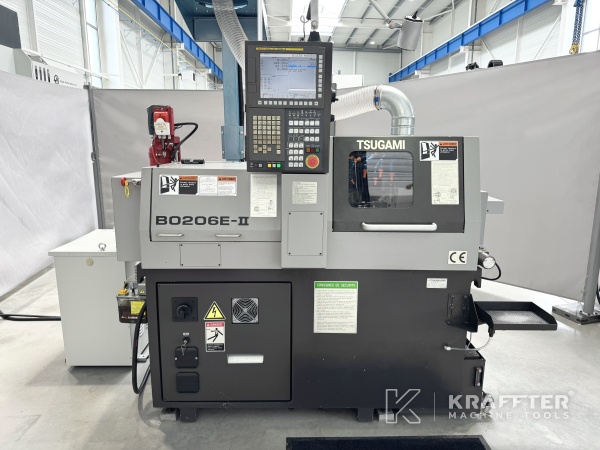
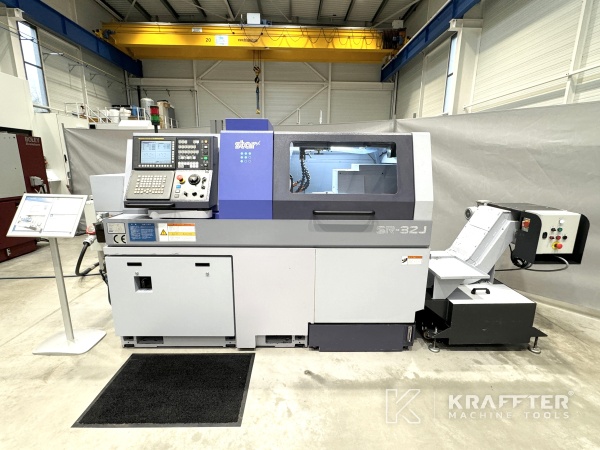
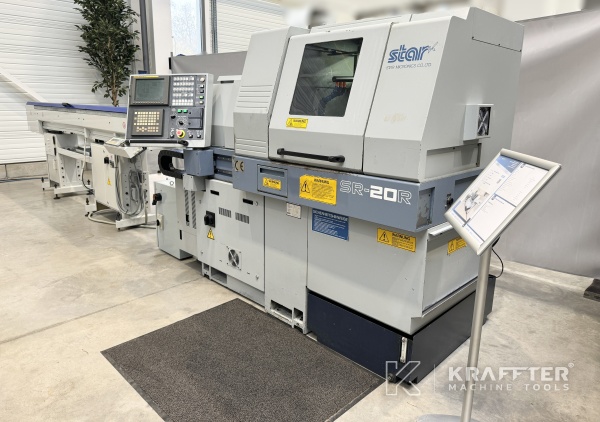
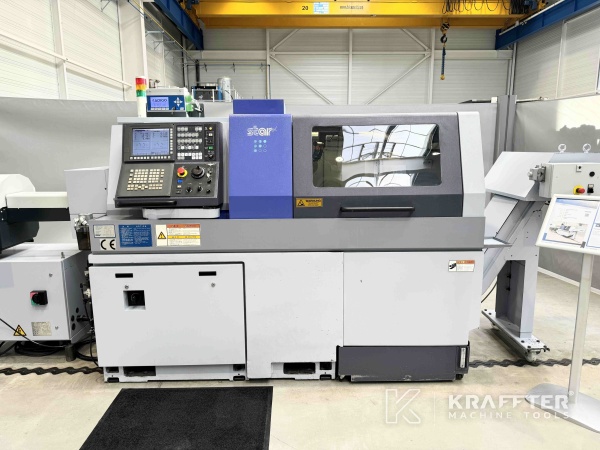
Sliding headstock lathes (CNC Swiss lathes): Technical & commercial guide
CNC sliding headstock lathes, also known as CNC Swiss lathes or automatic Swiss-type machines, are specialised turning machines in which the bar of material moves forward longitudinally as the tool machines the rotating part. In concrete terms, the material (generally presented in the form of bars) is driven in rotation AND longitudinal translation during machining, thanks to the particular design of the machine which uses a guide bush. This guide bush centres the bar as close as possible to the cutting tool. Only the portion to be machined protrudes from the guide bush, which ensures continuous support of the bar, virtually eliminates any deflection or bending of the bar and improves machining accuracy.
Historically, this turning technology was developed at the end of the 19th century in Switzerland for the watchmaking industry. Jakob Schweizer, a watchmaker from Bienne, is credited with having invented the first sliding headstock lathe, capable of mass-producing long, thin and complex parts with great precision. Since then, the concept of the ‘Swiss-type automatic lathe’ has become the benchmark for precision bar turning and has evolved considerably with the addition of computer numerical control (CNC) and multiple axes. Today, CNC Swiss lathes are used worldwide for machining small, complex and precise metal parts, particularly in the automotive, medical and electronics industries.
FAQ :
CNC travelling head lathe: advantages and disadvantages
Advantages
- Ultra-precision on small elements
- Repeatability and consistent quality
- Complete machining in a single operation
- High productivity & reduced cycle time
- Excellent finish and fewer reworks
- Suitable for long and slender elements
- Quick series changeover (for similar parts)
Disadvantages
- Limited to small bar diameters
- Expensive investment and tooling
- Complexity of adjustment and need for qualified personnel
- Less versatile for machining outside of bars
- Material waste and material yield due to guide bush
- Demanding upkeep and maintenance
The different types of sliding headstock lathes
As with the conventional lathe and the turning/milling centre, there are several categories and configurations of sliding headstock lathes, meeting various needs depending on the stroke, speed, level of product detail, type of machined products, etc. They can be differentiated according to the presence or absence of a guide bush, their hybrid design or their number of spindles:
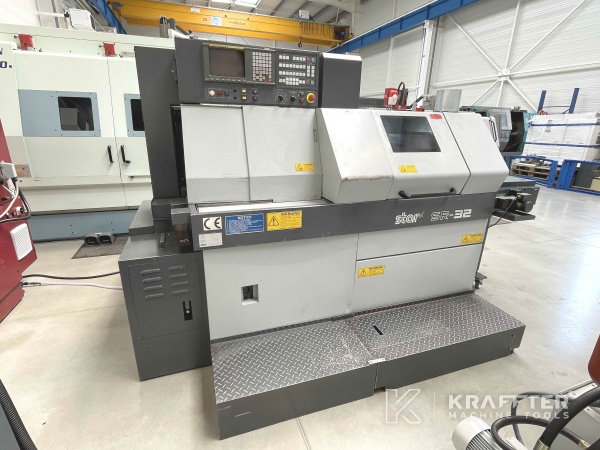
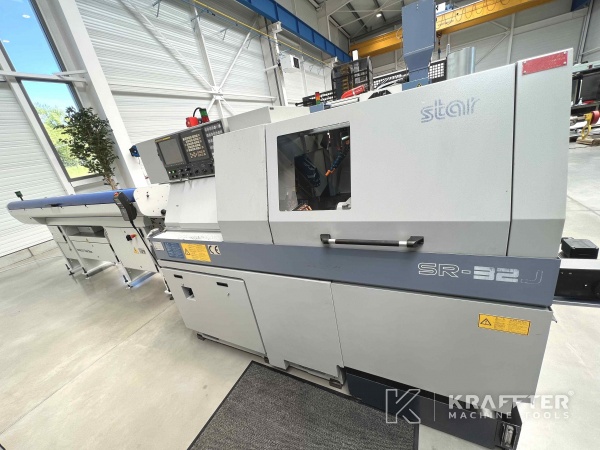
With or without guide bush: Traditionally, the guide bush is at the heart of the ‘Swiss’ principle for machining slender elements. However, some recent CNC machines offer the possibility of working without a guide bush when the geometry of the part allows it. For example, the manufacturer of sliding headstock lathes STAR offers convertible models that can operate with or without a guide bush. In barrel mode, it produces parts that are very long in relation to the diameter, with optimal material support. In barrelless mode (sometimes called ‘fixed headstock’ mode on these hybrid machines), shorter parts are favoured: the absence of a barrel reduces the length of bar waste at the end of machining and simplifies certain adjustments, while retaining the advantages of the moving head for precision.
Lathes that are hybrid or convertible: As mentioned above, some combine the two modes. They can operate in conventional sliding headstock mode or reconfigure themselves into fixed headstock mode. These hybrid models provide great flexibility: for example, being able to machine long elements in turning mode, then switch to conventional CNC lathe mode for short elements or those with a diameter close to the maximum capacity. This avoids the need for two separate machines and optimises the workshop. Manufacturers such as Tornos, Citizen and Star offer this type of convertible machine on certain models (e.g. Tornos Swiss DT or XT, Star SR series in ‘Type N’ version, etc.).
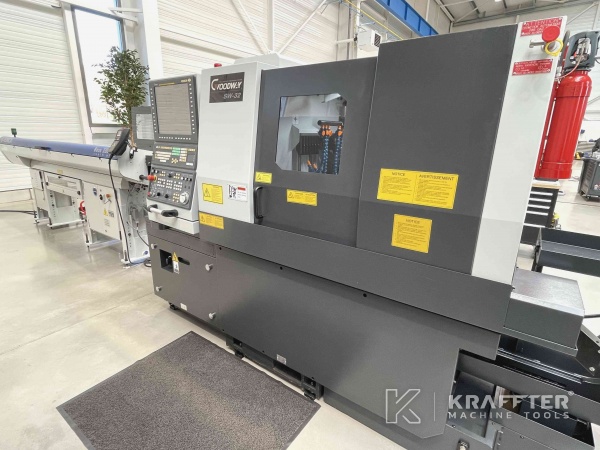
Swiss-type multi-spindle machines: In order to drastically increase productivity, there are models that combine the Swiss lathe principle with the multi-spindle concept (several bars machined in parallel). Historically, Swiss-type multi-spindle turning machines were cam-type, but there are now CNC versions inspired by the Swiss concept. For example, the Tornos MultiSwiss 6x14 is a machine with 6 main spindles that aims to be a link between the traditional multi-spindle lathe and the Swiss CNC lathe, integrating a guide bush for each spindle. This sophisticated equipment can simultaneously machine several parts at the same time, each with its own tailstock, which is suitable for very large series. However, they represent a much higher investment and complexity of implementation, justified above all for mass production where every second gained is crucial.
Number of axes and tooling configurations: There are also variations in the number of CNC axes (generally from 5 to 9 axes on modern Swiss lathes) and in the tool holder architecture. All CNC sliding headstock turning machines are equipped with a main spindle driving the bar, and most also have a counter spindle (second spindle) allowing the workpiece to be picked up from the rear to machine the back face and eject the finished part. In addition, these machines are equipped with several tool holders (turning, milling, drilling) mounted on plates or turrets. Some high-end models incorporate a B axis (angular orientation of the tools) or additional Y axes, further increasing the machining possibilities. For example, the Star SR series includes 7, 8 or 9-axis versions depending on the model, with up to one continuous B axis as an option, which allows parts to be machined from various angles and complex milling operations to be carried out. The choice of configuration (axes and tools) will depend on the products: complex geometries with several faces, transverse or angular machining will require more axes and motorised tools than a simple cylindrical part.
Which industrial applications are used for a CNC sliding headstock lathe?
Sliding headstock lathes are particularly popular for the manufacture of high-precision parts, which are small in diameter and often have complex geometries. Initially designed for Swiss watchmaking (very small micromechanics), the technology has spread to many demanding industrial sectors.
Today, it is used in a variety of fields:
Precision bar turning (subcontracting) – The term bar turning historically refers to the mass production of small turned parts from bars, particularly in the Cluses region (Haute-Savoie) in France and French-speaking Switzerland. Swiss CNC lathes are the main tool of bar turning companies, which subcontract the production of millions of parts for other industries. These may be special screws, pins, rivets, connectors, etc. These workshops appreciate sliding headstock lathes for their productivity in large series and the constant precision from one part to another. For example, in the luxury goods and watchmaking sectors, these machines manufacture miniature screws, winding stems and high-end pen casings, with tolerances of less than a few microns.
Medical and dental – The medical sector is an emblematic field for Swiss lathes. They manufacture surgical implants (osteosynthesis screws, bone screws for fractures, dental implants, small joint prostheses) and high-precision surgical instruments. These products require an excellent surface finish and absolute dimensional accuracy (tolerances of less than 5 µm) to fit perfectly with the human body. CNC sliding head machines are excellent in this role: they can display very tight tolerances while ensuring perfect repeatability over large series. In addition, most of these machines have enough power to machine difficult materials such as medical stainless steel or titanium while maintaining the required quality. For example, a biomedical titanium screw with a fine thread, a countersunk head and transverse holes can be made in a single operation on a Swiss lathe, ready for use without manual reworking. Medical device manufacturers exploit this capability to guarantee the conformity and reliability of critical parts.
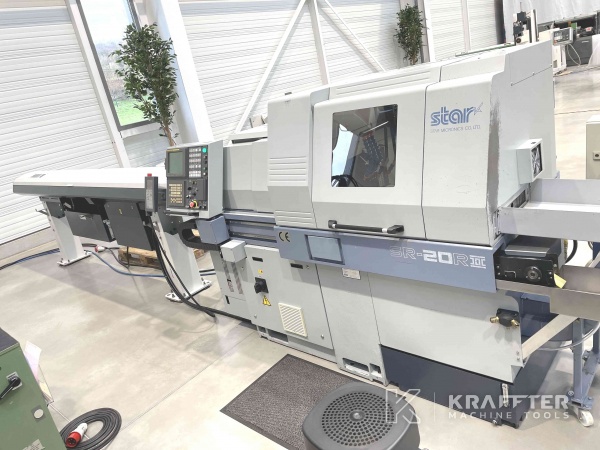
In short, for the medical sector, the focus is on precision, repeatability and the ability to machine difficult materials (titanium, stainless steel) cleanly. Models with a 20 mm bar passage (SR-20, Citizen L20, Tornos DECO 20) are very successful in this sector.
Aeronautics and aerospace – In aerospace, precision CNC turning technology is also used for many vital and complex components. Although the sizes of components in aeronautics are often larger, there are a multitude of small connection, fastening or actuating parts that require precise machining in series. For example, avionics electrical connectors, fasteners and special screws made of refractory alloys, engine components or hydraulic systems (nozzles, axles, etc.) a few millimetres in diameter are often manufactured on sliding headstock lathes. These machines make it possible to maintain strict tolerances even in hard materials (Inconel, aeronautical grade titanium) and to carry out a series of complex operations (oblique drilling, grooving, threading, etc.) on the same component. The aeronautics industry also values the reliability and repeatability of the process to guarantee quality over long production runs.
Electronics and connectors - Modern miniaturised electronics uses small machined metal components, which are found in connectors, sockets, contacts, etc. Automatic Swiss-type machines are again a preferred tool for producing these micro-components. For example, the manufacture of brass connector pins or contacts with special shapes (grooves, collars, through-holes) is done efficiently on these machines. A conventional CNC lathe would find it difficult to achieve the speed and level of detail required on very small, complex parts, whereas Swiss-type machining excels in this area. In addition, thanks to the possibilities of CNC threading and milling, these lathes can be used to machine small coaxial connectors, fibre optic end pieces, or electronic sensor bodies requiring several shapes in a single piece. The electronics sector thus benefits from the versatility of sliding headstock lathes to produce ever smaller and more complex parts in non-ferrous metals (copper, aluminium) or steels.
Automotive – The automotive sector values production speed and reliability on a 24/7 basis. This industry traditionally uses bar turning machines for the very large volumes of small parts used in the composition of vehicles. Examples include components for injection systems or carburettors, parts for valves or gearboxes, components for automotive electrical connectors, and parts for ABS. These parts often have to be produced at a rate of several thousand per day with consistent quality. CNC sliding headstock lathes, equipped with automatic bar feeders, are capable of carrying out these production cycles 24/7 while maintaining tight tolerances. Manufacturers and equipment suppliers take advantage of this technology to produce smaller and more complex car components at a reduced unit cost, with optimised manufacturing processes and improved production rates. For example, a small steel hydraulic distributor piston or fuel spray nozzle, with precise holes and complex profiles, can be produced entirely on a Swiss multi-axis lathe, where it would have taken several operations on a conventional lathe. This saving in time and productivity is a major advantage in the automotive industry, without compromising the final quality of the part.
In short, wherever there is a need for the mass production of relatively small, very precise parts, often with complex shapes, the CNC lathe with sliding headstock provides an effective solution.
Purchase a second-hand sliding headstock CNC lathe with complete peace of mind
The purchase of a second-hand Swiss CNC lathe is an option increasingly considered by manufacturers, and for good reason: these machines are built to last and retain most of their performance even after many years of service. The second-hand market for sliding headstock lathes is quite active, particularly in the industrial centres of the bar turning industry (France, Switzerland, Germany, Japan, etc.). Workshops often renew their equipment to move to more recent models, which frees up machines that are still fully operational at attractive prices for other users. Here is why and how the second-hand market can be relevant:
An economical alternative:
The first advantage is obviously the lower price. A well-maintained second-hand machine tool can very often offer performance comparable to new, but for a much lower investment. This allows smaller or budget-constrained companies to acquire cutting-edge technology without burdening their cash flow. For example, a new high-end Swiss CNC lathe can cost several hundred thousand euros, whereas the same model that is 10 years old could be purchased for a fraction of that price, while still remaining accurate and productive. For starting a new bar turning activity or adding production capacity, second-hand goods reduce the investment threshold.
Immediate availability:
Unlike buying a new machine, which can involve manufacturing and delivery times of several months, a second-hand machine is generally available immediately. This means that a need for additional capacity can be met quickly. It is an advantage for seizing a market opportunity without delay (large unforeseen order, new contract requiring more machines). In addition, it is often possible to see the machine in operation at its current owner's premises, which gives confidence in its capabilities before purchase.
Important points to check when purchasing a second-hand CNC sliding head lathe:
Buying a second-hand CNC lathe is not without risk, and it is important to be vigilant on several points to avoid unpleasant surprises.
The general condition of the machine should be closely inspected: ideally, it should be possible to see it in operation (under power) to judge the machining precision, listen to the spindles (noisy bearings would indicate wear), and check the geometry if possible (washer tests, spindle/counter-spindle alignment).
The level of maintenance and the history: a machine that has been maintained by the manufacturer or its distributor will be a much better choice. It is also recommended to inquire about any repairs that may have been carried out (replacement of the spindle, ball screws, etc.).
The operating hours or the parts counter can give an indication of wear (although this is not the only criterion). A bar turning machine running in 3x8 can accumulate a lot of hours in a few years - this is not a deal breaker if maintenance has been carried out, but it should be taken into account in the price.
The condition of the guide bush and the guideways deserves attention: these are highly technical elements, and excessive wear would result in a loss of capacity. Similarly, inspect the counter spindle and the auxiliary axes (Y, C) during operation.
The numerical control: is it a model still supported by the manufacturer (spare parts available, after-sales service)? Some older machines have obsolete CNs that are more difficult to repair in the event of electronic failure - favour standard controls (Fanuc, Mitsubishi) that are still common.
The accessories supplied: a Swiss lathe without its bar feeder or its guides and clamps is not operational – make sure that the sale includes the appropriate automatic bar feeder, a set of guide bushes of different diameters, and basic tools. This will avoid additional expenses and the hassle of finding these accessories.
Where can you buy a second-hand lathe and who can you trust?
You can find second-hand Swiss CNC lathes through several channels: classified ads and dealers specialising in second-hand machine tools, or directly from a company that sells its equipment. Going through a dealer such as Kraffter Machine Tools has the advantage of machine verification and reconditioning (cleaning, repairs, return to operational condition, testing). The price will be a little higher than if you buy direct, but the service brings peace of mind.
Speaking of peace of mind, Kraffter Machine Tools lets you benefit from its mastery of the supply chain, so that it can take care of all your national and international shipments with care and efficiency. Depending on your requirements, we offer specific packaging such as ISPM15-certified wooden crates, supplemented by SEI4C vacuum packaging, guaranteeing optimal protection throughout the transport. Our flexible solutions allow for loading from the top (open top for sea containers) or from the side, thus ensuring maximum safety and simplicity. Furthermore, all our road transport is carried out without breaking bulk or transhipments, guaranteeing the perfect integrity of your machines until they reach their destination. Finally, our dedicated team takes full charge of customs formalities, thus simplifying your logistics and allowing you to remain calm at every stage.
Would you like to sell your machine tool? Find all the necessary information by clicking here
Who is the second-hand market for CNC sliding head lathes aimed at?
The second-hand option is particularly aimed at:
·
- SMEs or emerging workshops that want to equip themselves at a lower cost to get started in CNC bar turning.
(If you are a service provider who serves various markets (a little automotive, a little medical, etc.), the key word will be versatility. You will therefore need a machine that is flexible enough to adapt quickly to different parts. Opt for a sliding headstock CNC lathe equipped with a maximum number of axes and tools, so that it can handle most of the geometries required. Models with a removable bar guide (convertible to a fixed headstock) may be of interest, as you can also take on work on short pieces without being restricted by the bar drop. Also consider the availability of collets and guides for different diameters: a subcontractor must be able to switch from Ø5 to Ø15 and then to Ø3 in the same week, so they must have the complete kit of guide rings and collets, and ideally a lathe where this change does not take a whole day.
- Established companies that need an additional turning device for a one-off contract or to relieve existing machines, without wanting to invest in new equipment.
- Possibly, industries in the prototyping phase: buying second-hand allows for in-house testing and development, and then if series production is confirmed, they can invest in new equipment later.