













CNC SURFACE GRINDER: PRECISION, LEADING BRANDS AND THE BENEFITS OF HIGH-END USED MACHINES
The CNC surface grinder has become the preferred precision machine-tool technology for achieving perfectly flat surfaces and exact dimensions.
However, these high-tech machine tools represent a significant investment when purchased new. That is why it is worth turning to the high-end used machinery market to buy a refurbished used CNC surface grinder in excellent condition, at a fraction of the cost of a new machine, with the added advantage of immediate availability.
By working with a recognized specialist such as Kraffter Machine Tools, you can find a premium-brand used CNC surface grinder, fully tested and ready for production.
FAQ :
What is a CNC surface grinding machine?
A surface grinding machine is a finishing machine tool designed to machine perfectly flat surfaces with extreme precision. It carries out a process called grinding, which consists of removing material by abrasion using a grinding wheel. This rotating abrasive wheel shaves the surface of the part to correct any remaining defects in flatness and roughness, often after prior machining by milling or turning. The result is a surface with very low roughness and exact dimensions, even on hard or treated materials (hardened steel, carbides, ceramics, etc.).
In a conventional surface grinding machine, the workpiece is fixed on a table that moves under the grinding wheel. The grinding wheel, mounted on a motorised spindle, comes into contact with the workpiece to remove a few microns of material with each pass. On a CNC surface grinder, these movements and passes are controlled by a numerical control (NC) or CNC. This makes it possible to automate the process with a high degree of precision and to carry out complex operations repeatedly, without continuous manual intervention.
Modern CNC surface grinders incorporate advanced technologies such as workpiece-measuring probes, automatic wheel dressing systems, high-performance cooling and filtration of cutting fluids, and electronic drives. This equipment guarantees excellent repeatability to achieve very low surface roughness (Ra of the order of a few tenths of a micron) and dimensional tolerances to the sub-hundredth (less than 0.01 mm) on small production runs or tooling. In other words, a well-configured CNC surface grinder can obtain surfaces of almost perfect flatness, impossible to achieve using other machining methods.
The different types of surface grinding machines
There are several types of surface grinding machine, distinguished by their control method and mechanical design. Understanding these variants will help you choose the right machine for your needs:
Control mode :
- Manual (or conventional) surface grinding machine: This is the simplest version, where the table and grinding wheel movements are controlled manually by the operator (using handwheels) or assisted by basic systems. It is suited to small workshops for one-off operations or very small production runs. A hydraulic surface grinder is an intermediate case where the longitudinal movement of the table is driven by a hydraulic cylinder - this automates the back and forth movement of the table, but without the intelligence of an NC. These manual/hydraulic machines are suitable for simple, low-cost surface grinding jobs, but require operator know-how to achieve good precision. See examples of used conventional surface grinders
- Also in this family are mini surface grinders (compact size/small footprint), designed for small parts and finishing/adjustment stations. These machines typically have very small usable surfaces (e.g. tables from around 200 × 100 mm depending on the range): ideal when space is at a premium and workpieces are small.
- Automatic (or semi-automatic) surface grinder: The automatic surface grinder is positioned between the manual and the NC: it retains a "workshop" logic but adds automatic cycles and feeds (depending on configuration), to gain in repeatability and output on short to medium production runs. In practical terms, it can be
- Hydraulic: the table's longitudinal reciprocating motion is hydraulically powered, and the machine can incorporate automatic transverse feed and automatic infeed/outfeed functions (depending on options).
- PLC-controlled: the PLC manages a simple cycle (scanning, feed rate, infeed, stops, etc.) with a more basic interface than an NC, but often sufficient for repetitive surface grinding.
- CNC (numerically controlled) surface grinding machine: Here, all the axes are computer-controlled. The operator programmes the grinding parameters (spindle speed, passes, paths) and the machine automatically executes the cycle. The CNC surface grinder offers superior precision, automated cycles (including wheel dressing and wheel wear compensation), and the ability to sequence different operations without resting the workpiece. It excels on complex parts or production runs where consistency of result is paramount. For example, a CNC will be able to grind a precise profile or multiple cavities in a single set-up, where a manual could not easily do so.
Mechanical design :
- Surface grinder with tangential grinding wheel (straight table): This is the most common design of surface grinder. The grinding wheel is mounted on a horizontal spindle, so that it is the periphery of the wheel (its cylindrical face) that works tangentially on the surface of the workpiece. The workpiece is clamped on a rectangular table that generally moves back and forth longitudinally and transversely to cover the entire surface. This type of surface grinding machine with tangential grinding wheel can be used to machine flat surfaces on workpieces of various shapes (rectangles, guides, blades, etc.) with high angular accuracy and excellent parallelism. This is the preferred configuration for precision mechanics in general.
- Rotary table surface grinder (vertical spindle): On this type, the table is circular and rotates continuously under the grinding wheel, while the wheel spindle is generally vertical (the flat face of the grinding wheel - like a disc - makes the cut). Often referred to as rotary table grinders, they are used for specific applications such as surfacing circular workpieces or grinding industrial blades and knives. The continuous rotation of the table combined with the gradual descent of the grinding wheel ensures uniform grinding. These machines offer high productivity on parts with adapted geometries (round shapes or parts requiring simultaneous grinding over the entire surface). They are used, for example, for sharpening saw blades or grinding flat sealing surfaces.
Note: There are also surface grinders with a moving column (or gantry) for very large dimensions. In this case, it is not the table that moves longitudinally, but the grinding head that moves along a beam, making it possible to grind extremely large parts (several metres long) without sacrificing rigidity. These special machines are used in some heavy sectors, but are less common.
Typical industrial applications for a CNC surface grinder
CNC surface grinders are used wherever perfectly flat surfaces, uniform thicknesses and impeccable finishes are required. Many industrial sectors and mechanical trades use surface grinding, including :
- Tooling and moulds - In the manufacture of press tooling, dies or moulds for plastic injection moulding, the CNC surface grinder is essential for adjusting mould parts, plates and shims with micrometric precision. For example, for an injection mould, the parts need to be ground to ensure a perfect seal and closure. Similarly, punches, stamping dies and other hardened steel tooling components are often ground after heat treatment to achieve exact final dimensions and a flawless surface.
- Precision engineering - Precision engineering workshops commonly use surface grinding for parts such as machine tool slides, prismatic guides, assembly shims, gauges, etc. For example, lathe slide guides (long straight parts) are ground to ensure they are linear and parallel. Thanks to the surface grinding machine, perfectly straight surfaces or surfaces at precise angles can be obtained, with a regularity that no milling could achieve.
- Aerospace - In these fields, components often have to meet very tight tolerances. CNC surface grinding is used, for example, to finish landing gear parts, skids, assembly wedges or certain turbine parts that require absolute flatness. As the exotic alloys (titanium, Inconel, etc.) used in aerospace are very hard, wheel machining is ideal because it can be applied to hard or abrasive material without any significant loss of removal efficiency.
- Automotive - The automotive industry uses surface grinders to machine engine parts (e.g. the surface of the engine block where the cylinder head rests, ground to ensure watertightness), transmission components or manufacturing tools. In maintenance, grinding a cylinder head after overheating is a common operation to restore its flatness. In manufacturing, certain parts undergo surface grinding to guarantee an optimum surface finish (for example, the faces of gearbox pinions or segments).
- Cutting tools and sharpening - Sharpeners use small surface grinders (sometimes called grinding machines when equipped with special devices) to resharpen cutting tools, industrial knives, guillotine blades, etc., obtaining a straight edge and a polished blade surface. Here again, the grinding wheel ensures perfect surface quality.
- Other industries - Surface grinding is also used in the medical sector (prosthetic implants with a flat surface, surgical instruments), the energy sector (turbine parts, valves - a valve grinding machine is actually a small surface grinding machine dedicated to valve seats), the watchmaking industry (movement parts requiring a mirror finish), and so on. In short, whenever a part requires flatness or a surface finish that goes beyond what milling or turning can offer, the surface grinding machine is the solution. It offers an unrivalled level of precision and finish, while making it possible to process materials that would be difficult for other machines to machine.
Finally, surface grinding offers unique advantages over other surface machining processes. For example, workpiece clamping is generally very simple; on most grinding machines, a magnetic plate (electromagnets or permanent magnets) makes it easy to hold steel workpieces during machining. What's more, tooling costs are relatively low: a grinding wheel often costs less than a special milling cutter or a complex cutting tool, and it wears slowly while being able to be straightened several times. These advantages translate into high productivity and efficiency in workshops equipped with them.
What are KRAFFTER's criteria for choosing a CNC surface grinding machine?
Follow KRAFFTER's recommendations to select the cnc surface grinder best suited to your activity:
Faced with the variety of models and configurations of surface grinding machines, it is important to define your selection criteria according to your industrial activity and the workpieces to be machined. Here are the main points to consider when choosing the ideal machine:
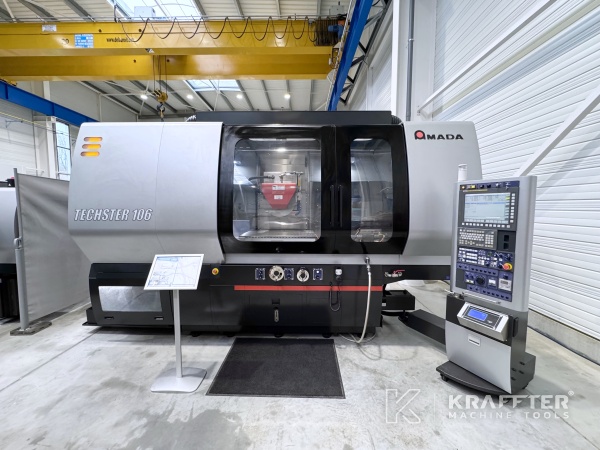
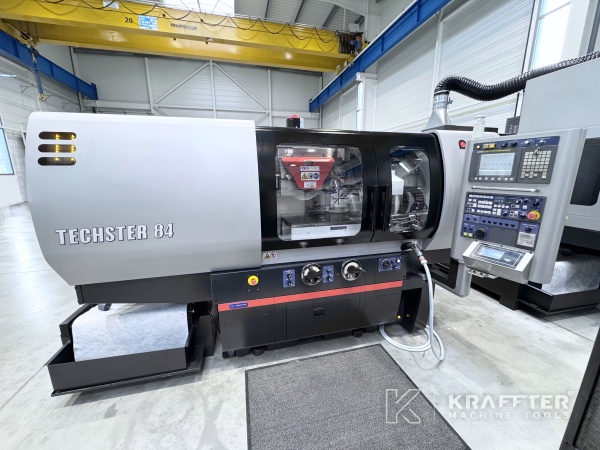
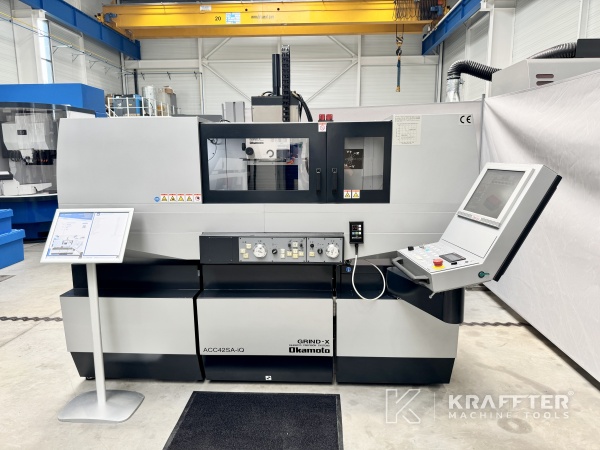
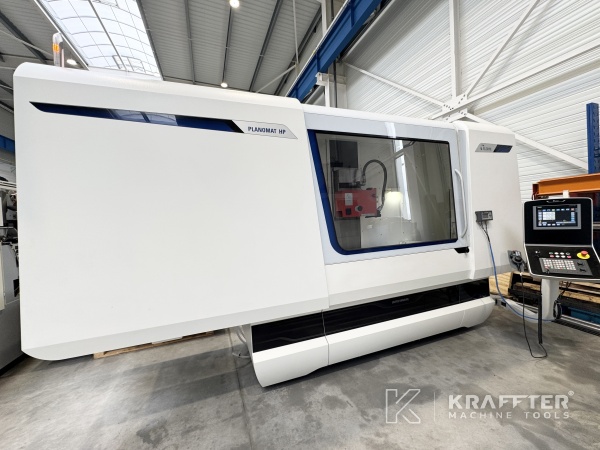
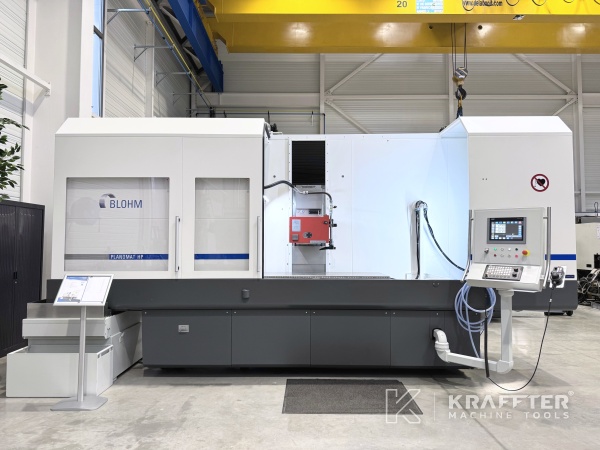
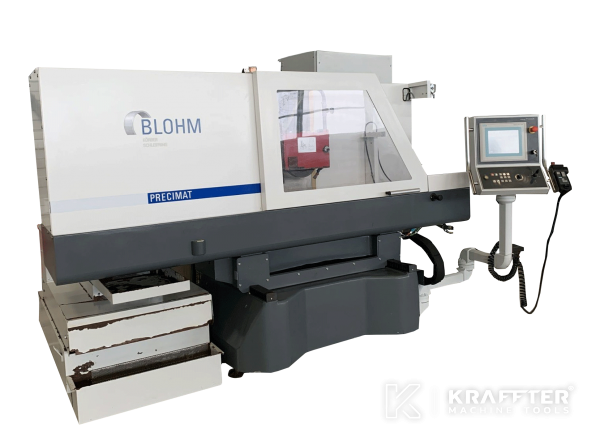
- Table dimensions and machine capacity: The size of the table determines the maximum dimensions of the workpieces you can grind. Analyse the length, width and height of the typical workpieces you produce. For example, if you mainly manufacture small parts or tooling such as shims and tools (a few hundred millimetres), a 500 x 200 mm CNC surface grinder (500 mm x 200 mm table) may be sufficient. A compact model such as the OKAMOTO ACC42SA-iQ (grinding area ~400×200 mm) is perfectly suited to small parts, cutting tools, etc. On the other hand, for larger moulds or plates (several hundred mm to more than a metre), a larger capacity machine is required - for example an 800 x 400 mm or 1000 x 600 mm table. Kraffter offers the AMADA Techster 84 ( 800×400) and Techster 106 (1000×600) as reconditioned second-hand machines, adapted to these part sizes. For even larger workpieces (large mechanical parts, machine bases), models such as the large-format BLOHM Planomat or double-column machines can be used. The BLOHM Planomat 616 HP has a usable surface area of 1600 × 600 mm, covering the needs of tooling, moulds and large parts. So consider your largest parts and choose a machine whose X/Y/Z travel can accommodate them with a margin.
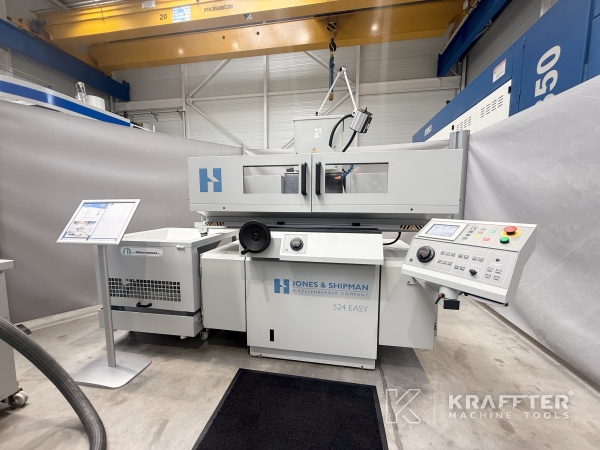
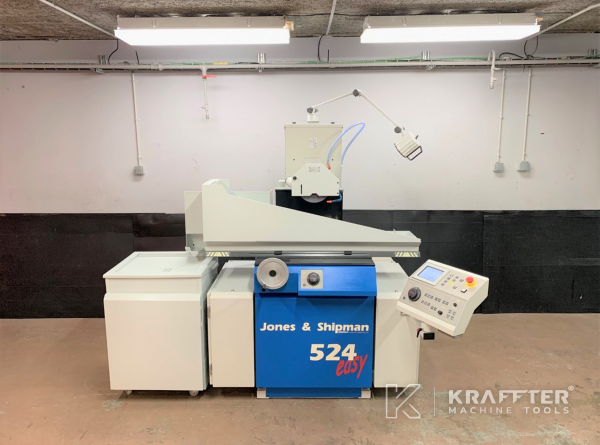
- Precision and rigidity required: Not all CNC surface grinders are created equal in terms of precision. The tolerances to be achieved on your workpieces (flatness, thickness, parallelism) will guide your choice. The top-of-the-range machines sold by KRAFFTER (Studer, Blohm, Okamoto, etc.) often incorporate digital measuring rules on the axes, high-precision guideways (hardened slides, recirculating ball or hydrostatic pads) and robust spindles. If you need to maintain micron-level tolerances, choose a model with a reputation for rigidity and geometric control. For example, the Jones & Shipman 524 Easy is a CNC surface grinder known for its accuracy and user-friendliness, designed to deliver tight tolerances in the toolroom. Similarly, the Blohm Planomat range is renowned for its robustness and ability to maintain flatness over long lengths. Don't hesitate to examine the specifications: axis straightness, claimed repeatability, etc., and to test the machine (table flatness check, squareness) before purchasing. Kraffter allows you to check the geometry of its machines in its showroom (ISO inspection of flatness, ball screw clearances, spindle vibrations, etc.) to guarantee the claimed precision.
- Spindle power and type of grinding wheel: The motor power of the spindle and the diameter of the grinding wheel it can drive will determine your material removal capacity. For large surface parts or if you are removing a lot of material (straightening a deformed blank, for example), a powerful spindle is needed to avoid slowing down and overheating. A small 2 kW grinder (like the Okamoto ACC42, ~2.2 kW) will suffice for finishing or small parts, but for large surfaces in hardened steel, 10-20 kW spindles are preferable (the Blohm 616 HP reaches 15 kW). The type of grinding wheel is also a factor: cup wheel, flat wheel or cylindrical wheel, with corundum, CBN or diamond abrasive depending on the materials being machined. Make sure the machine can mount the appropriate wheels (size, standard bore) and has a hub to balance the wheel. Some CNC grinders incorporate automatic or semi-automatic wheel balancing and dressing wheels to revive the wheel during the cycle - an advantage if you are aiming for continuous production and consistent surface finish.
- CNC control and user-friendliness: Not all CNCs are equal in terms of grinding functionality. Some older machines have CNCs that are limited to simple automatic movements, while more recent machines offer conversational interfaces, assisted manual or learning modes, making them easier to learn. The Jones & Shipman Easy, for example, lives up to its name by offering Easy software that enables an inexperienced operator to become productive quickly, thanks to predefined cycles (plunge grinding, alternate passes, auto dressing, etc.). Similarly, the iQ interface on the Okamoto ACC42SA-iQ with its colour touch screen makes programming intuitive. Think about training your operators: an ergonomic interface and the possibility of switching to manual mode for touch-ups can be important selection criteria. Also check the ISO language accepted, the programme memory, compatibility with your software (CAM if applicable), or the presence of specific automatic cycles (e.g. separate roughing and finishing cycles, programmable straightening cycle, etc.).
- Options and equipment: Finally, the industrial equipment supplied with the machine can make all the difference. A magnetic platen of the right size and in good condition is essential for clamping your workpieces (and a cost saving if supplied). A coolant system (coolant tank, pump) with high-performance filtration (paper filter, magnetic separator) is crucial for removing heat and grinding dust, especially in intensive production, where a filtration system will prevent scratching by recirculating particles. Extraction of oil mist or dust may be necessary for health and cleanliness (some Kraffter machines include SARA or IFS filtration/aspiration units, for example). Other useful options include an automatic wheel dresser (to keep the wheel sharp and cylindrical without manual intervention), digital axis display on manual models, or an automatic wheel changer on some top-of-the-range CNC models. List your needs: are you going to grind non-magnetic material (if so, provide clamps or a vacuum plate), do you need an angle device for chamfering, etc.? A well-equipped second-hand machine will save you money on accessories later on.
To sum up, define the profile of use of the CNC surface grinder in your company: type of parts (size, material), level of precision required, production volume (one-off or continuous flow), skills available in-house, and budget. These factors will help you choose the right model and configuration.
Don't hesitate to ask us for advice. We know the specific features of each make and model, and we'll be happy to guide you towards the grinding machine best suited to your industrial processes.
Why choose a reconditioned used surface grinder?
When buying a CNC surface grinder, there's an important question to ask: should you invest in a new machine or opt for a second-hand machine reconditioned by a specialist? Here's a comparison of the advantages of a top-of-the-range used CNC surface grinder, particularly when you use the services of a reconditioning specialist like Kraffter, compared with buying a new machine:
- Immediate availability, immediate production
A new machine often takes several months, sometimes more than a year.
With a reconditioned used CNC surface grinder, the machine is in stock, visible and testable. You can see it powered up in the showroom, run cycles, check the actual condition of the table, the ball screws, the spindle, the options... and leave with a machine that's ready for production. This transparency offers peace of mind, because you know exactly what you're buying, with no surprises when it comes to commissioning.
As aresult, your workshop can respond more quickly to a new contract or increased workload.
- Quality and geometry secured by reconditioning
Kraffter applies a strict reconditioning process to every machine we receive.
- complete diagnosis,
- thorough cleaning,
- reconditioning of mechanical, electrical, hydraulic, pneumatic and CNC assemblies,
- checking of critical components and replacement if necessary with original or equivalent parts from major suppliers
- refabrication of specific parts as required using in-house machinery
- geometry is then revalidated to manufacturer / ISO standards.
You are buying a second-hand machine whose accuracy has been checked, with the assurance that it will be brought up to the highest metrological standards. Thecondition (mechanical and cosmetic) is like new, but at a much lower cost.
- Reduced investment, controlled financial risk
The first owner has already absorbed the discount on the new car. So you get a top-of-the-range CNC surface grinder for a fraction of the price of new, with a much lower capital outlay and a better-preserved residual value.
In short, you minimise the financial risk of renewing your production equipment.
- Verified reliability and workshop testing
At Kraffter, every surface grinder is tested in the workshop before being put up for sale: dynamic tests are carried out, reproducing the tests recommended by the manufacturer (checking the table surface, orthogonality, straightening test, etc.). Future buyers are even advised to come and carry out their own tests or checks in line with their own good business practice. The reliability of the equipment is therefore guaranteed, and you benefit from a machine that is immediately operational. What's more, the machine's history is often known (year, origin, maintenance carried out) and well documented.
- Logistical control:
Kraffter also manages preparation and transport: axis clamping, appropriate packaging (cover, ISPM15 sea crate), convoying without transhipment in France or abroad. You receive a flat grinding machine ready to install, with no unpleasant handling surprises.
In the end, a reconditioned used CNC surface grinder from Kraffter offers the best compromise: the performance of a major brand, the security of a serious reconditioning, and the affordability of a used machine.
All delivered safely to your workshop, ready to install.
What are the best brands of used CNC surface grinders?
Several manufacturers are recognised worldwide for the quality of their surface grinding machines. Some of the most famous are :
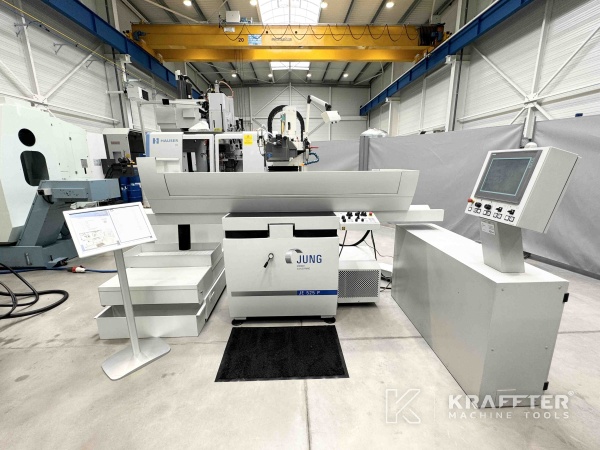
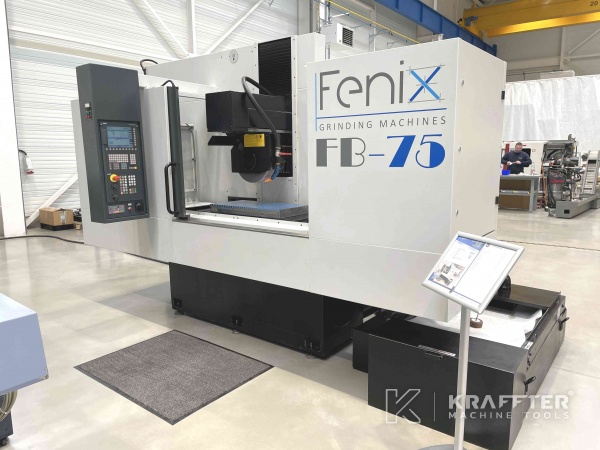
BLOHM (marque allemande du groupe United Grinding, célèbre pour ses rectifieuses robustes et précises – ex. la Blohm Planomat 616 HP), OKAMOTO (fabricant japonais leader, connu pour ses rectifieuses planes de haute précision – ex. Okamoto ACC42SA-iQ), AMADA (a Japanese brand which, in addition to sheet metal machines, produces modern CNC surface grinders such as the Techster 84/106 series), JONES & SHIPMAN (a historic British manufacturer, now part of Hardinge, with models such as the J&S 524 Easy combining precision and a user-friendly interface). We can also mention brands such as Fenix (an Italian manufacturer of flat grinding machines with a strong presence on the European market) and JUNG (from Germany, who, along with BLOHM, form the flat and profiled loop technology group within the United Grinding group).
The important thing is to choose a brand with a proven track record in terms of mechanical reliability and long-term service.
KRAFFTER Machine Tools concentrates its offer on these top-of-the-range brands with strong reputations, carefully selected for their proven performance. By opting for one of these brands on the second-hand market, especially via a specialist dealer, you can be sure of acquiring a durable, precise and well-documented machine.
What makes a Kraffter reconditioned surface grinder so valuable?
When you buy a used CNC surface grinder reconditioned by KRAFFTER, you are choosing peace of mind and performance for your workshop.
From the buyer's point of view, the value provided by a reconditioned KRAFFTER machine can be broken down into several complementary dimensions.
- Firstly, it's the guarantee of optimum quality: each machine is selected from leading brands for its reliability, then undergoes a complete overhaul in accordance with strict specifications (metrological checks, replacement of worn components, calibration). You receive a CNC surface grinder that is ready for production, with the assurance that its geometry and tolerances comply with the manufacturer's standards and ISO precision standards.
- Secondly, it saves invaluable time and responsiveness. Instead of waiting months for a new machine to be built, you get operational equipment almost immediately. This can enable you to fulfil a new contract or increase your production rate without delay. What's more, because the machine is already installed in the Kraffter showroom, you can see it running on site even before it arrives at your premises. This seamless transition guarantees a rapid and controlled start to production.
- From a financial point of view, opting for a reconditioned used grinding machine is a smart economic choice. The significantly lower initial cost preserves your cash flow or allows you to purchase a better-equipped machine in a higher range for the same budget. What's more, since Kraffter doesn't focus on quantity but on quality, every machine we sell receives special attention. We are committed to taking the time necessary to select machines recognised for their reliability and performance in precision mechanics, rather than multiplying references. This philosophy translates into a relationship of trust with our buyers: you know that the machine has been hand-picked and meticulously prepared.
- Kraffter's support adds even more value to your investment. From advice on choosing the right surface grinder to secure turnkey delivery, you benefit from expertise at every stage. Logistics preparation, secure transport and customs formalities... everything is orchestrated to ensure that you receive the machine in the best possible conditions. The result is greater safety (less risk of damage, no breakages on unloading) and simpler administration.
In short, a CNC surface grinder reconditioned by Kraffter offers your company an invaluable asset: accessible top-of-the-range precision, without compromise. You benefit from performance equivalent to that of a new machine, while enjoying all the advantages of a used machine. For users who demand precision, this approach represents a strategic alternative to investing in new equipment. It guarantees a rapid start to production and controlled budgeting, all with the peace of mind that comes from the transparency and reliability of a recognised specialist.
Our other grinding technologies :
In addition to CNC surface grinders, KRAFFTER also offers other grinding technologies to meet more specific needs: the CNC cylindrical and cylindrical grinding machine, dedicated to rotating parts (shafts, axles, bearing seats) with high requirements in terms of circularity, cylindricity, concentricity and surface finish, as well as the CNC coordinate grinding machine, designed for ultra-precise finishing of complex geometries (bores, profiles, shapes) with tight tolerance-oriented positioning and repeatability. These solutions are all part of the same approach: ensuring precision and process stability thanks to a machine that has been selected, inspected and reconditioned to KRAFFTER standards.