













Our used machine tool brands
Mikron – High-speed machining centre on the second-hand market
The acquisition of a second-hand machining centre represents a strategic decision for many industrialists in search of efficient, high-performance and economical solutions. In this context, Mikron equipment occupies a privileged place on the market thanks to its indisputable reputation combining Swiss precision, technical reliability and high-speed productivity.
The market for used Mikron machine tools thus offers an attractive opportunity for manufacturers looking for both high Swiss precision and medium- and long-term profitability.

The history of Mikron: from gear cutting machines to high-speed machining centres
Founded in 1908 in Biel (Switzerland) by watchmaker Karl Lüthy, Mikron began by manufacturing machining equipment for the watchmaking industry. Its first machines for cutting gears and tools contributed greatly to the industrialisation of Swiss watchmaking at the beginning of the 20th century. Over the decades, Mikron diversified its activities: in the 1960s, it extended its production to universal milling machines, machining systems and even plastic components. Strategic acquisitions strengthened its expertise, notably Haesler SA (Boudry) in 1962 in watch transfer machines, and Albe SA (Agno) in 1986, then the leader in rotary transfer machines for the manufacture of ballpoint pen tips. Listed on the stock exchange in 1983, Mikron gradually became a key player in precision machine tools.
During the 1990s, Mikron enjoyed a boom thanks to its high-speed production systems, but had to refocus after the sale of certain activities. In 1994, it sold its traditional gear cutting business to the German company Pfauter. It then made a significant breakthrough in 1996 by introducing high-speed machining centres (High Speed Milling), pioneers in this field. In 2000, Mikron sold its standard machining division (machining centres and CNC milling machines) to the GF AgieCharmilles group, making the latter the world number two in high-speed milling. Mikron then refocused its activities on two divisions: Mikron Automation (automated assembly solutions) and Mikron Machining (high-performance machining centres), while relying on Mikron Tool for the manufacture of dedicated cutting tools. Today, with around 1500 employees (in 2024) and production sites in Switzerland (Boudry, Agno), Germany, the USA, China, Singapore and elsewhere, Mikron continues its tradition of innovation in precision machining and automation.
Contribution of the manufacturer Mikron to the industry
For over a century, Mikron has made significant contributions to several industrial sectors thanks to its high-precision machines. Originally, its gear cutting machines standardised the manufacture of watch components, propelling the production of mass-produced watches while guaranteeing impeccable quality. Subsequently, by integrating rotary transfer technologies, Mikron revolutionised the manufacture of ballpoint pen tips – its systems now produce up to 200 million pen tips per day, or 95% of global production.
Mikron machining solutions are present in many fields:
- Automotive industry – Mass production of engine and chassis components. Around 7 million automotive parts (injectors, turbocharger turbines, etc.) are machined every day on Mikron machines. These machines can achieve very high rates (several hundred parts per minute) without sacrificing precision.
- Watchmaking and micromechanics – Machining of gear wheels, shafts and miniature components with micrometric precision, perpetuating Mikron's heritage in watchmaking. Mikron has equipped generations of watchmaking workshops with machines capable of producing the finest gears.
- Consumer goods (writing) – In addition to pens, Mikron equips the household appliance, electronics and other consumer goods industries by supplying flexible cells for the mass production of metal parts.
- Medical and pharmaceutical – Machining of medical device components, syringes and implants requiring extreme reliability and precision. Mikron machines guarantee minute tolerances and repeatability in line with industry standards.
- Aeronautics and energy – Although less often mentioned, Mikron's high precision is suitable for machining turbine blades, injection components or parts of electronic devices, sectors where any improvement in productivity and quality is crucial.
Thanks to this multi-sectoral presence, Mikron has had a major impact on high-precision machining in large series. Its systems can achieve production rates of up to 600 parts per minute while maintaining tolerances of around ±0.002 mm. This unrivalled combination of productivity and precision has not only improved industrial yields, but also opened up new manufacturing possibilities, making complex mass-produced parts economically viable. In short, Mikron has acted as a catalyst in the automation of precision machining, from micromechanics for the watch industry to safety components for the automotive industry, providing manufacturers with savings in terms of time, costs and quality.
Market positioning and strengths of Mikron machine tools
Mikron is a high-end specialist in the machine tool sector, facing competition from both large generalists and niche players. Rather than competing on volume with universal manufacturers, Mikron has built a reputation for customised, high-productivity solutions. The group is now considered an essential reference for precision machining equipment, particularly for the mass production of complex parts. Its main competitors in the field of high-speed 5-axis machining centres (HSM) include companies such as GF Machining Solutions (which has been integrating Mikron technology since 2000), DMG Mori, Hermle and Makino. In the transfer and assembly machine sector, Mikron faces other European specialists (e.g. Pfiffner, Hydromat, or Bihler) but retains a technological advantage for small, high-precision parts.
Several distinctive advantages explain why manufacturers choose Mikron:
- Swiss precision and long-lasting quality: Historically focused on watchmaking, Mikron has anchored precision at the heart of its machines. These offer tolerances of a few microns even over extended cycles, a guarantee of reliability for critical production (medical, aeronautics, etc.). The robust design ensures longevity and stability that make investments profitable over many years.
- Unrivalled productivity in large series: Mikron Machining offers solutions capable of producing at extremely high rates (hundreds of parts/minute) while fully automating flows. This unrivalled productivity, combined with a low reject rate thanks to quality, clearly sets it apart in the market. For example, Mikron's Multistar transfer machine can have more than 20 stations operating simultaneously, multiplying the output compared to conventional machining centres.
- Innovation and specialisation: Mikron has often been a pioneer, particularly in high-speed milling (HSM) since the 1990s. Rather than covering the entire range of machine tools, Mikron concentrates on specialised niches (micromachining, rotary transfer, compact 5-axis centres) where it provides innovative solutions (e.g. torque motors on rotary axes, integrated tool monitoring software, etc.). This targeted expertise is a guarantee of performance for customers whose needs correspond to these niches.
- Integrated solutions and customisation: Mikron does not just deliver standard machines – it offers turnkey systems, with automated loading/unloading stations, online control, and often specific adaptation to the customer's product. Its Mikron Tool division manufactures cutting tools optimised for its machines, guaranteeing a perfectly matched machine/tool combination. This vertical integration (machine + tooling + software) enables levels of efficiency to be achieved that are superior to a multi-supplier configuration.
- Global support and service: Manufacturers appreciate the sustainability of the support, especially the availability of spare parts, which make these machines particularly attractive on the second-hand market. In addition, Mikron machine tools are particularly suitable for reconditioning, an opportune choice for extending their use at the highest level.
In short, Mikron positions itself not by sales volumes, but by the added value of its equipment for demanding applications. Manufacturers choose Mikron when they are looking for extreme precision and automated mass production. This positioning has enabled it to retain customers in sectors where quality takes precedence over unit price, and to prosper despite competition from more generalist manufacturers.
Second-hand market for Mikron machines
Given the longevity and quality of Mikron machines, a large market for second-hand machine tools has developed around the brand. Numerous models, both conventional and CNC, can be found second-hand, offering interesting opportunities to manufacturers and craftsmen. Examples include the old WF21 and WF3 milling machines from the 1980s, the more recent VCE Pro and HSM machining centres, as well as the famous 102 gear cutting machines and various transfer systems, all regularly available through specialised dealers. Mikron is ‘now an essential brand’, and many of its machines are available on the second-hand market, often reconditioned by experts to offer a quality close to new.
Advantages of buying second-hand:
Mikron machines, renowned for their robustness, generally stand up very well to the passage of time: a reconditioned machine can regain a precision close to its original. In addition, immediate availability is an asset – no manufacturing lead time, the machine can be installed and productive in a few weeks. Some second-hand models can also be easier to use (e.g. conventional machines for training or one-off needs). Finally, buying second-hand minimises the discount in the event of resale: as the equipment has already suffered most of its loss of value, the investor runs little risk of a large loss of profit if he resells the machine later.
Market trends:
We can see that Mikron 5-axis machining centres (UCP, HSM series, etc.) from the decade 2000-2010 are very popular second-hand, as they offer current performance at prices well below new. Similarly, vintage Mikron gear cutting machines (102 series) are still sought after by independent watchmaking workshops and schools, which maintains their rating. Several companies have specialised in the rebuilding of Mikron machines, particularly in Switzerland and France, supplying refurbished models with a guarantee (replacement of ball screws, CNC updates, etc.).
Points to watch out for:
Buying second-hand does, however, require some consideration. It is essential to check the pedigree of the machine: number of hours on the clock, previous conditions of use, maintenance carried out. A machine that has been used in intensive 24/7 production may require a thorough overhaul (spindle to be replaced, slides to be overhauled) to restore its performance. The availability of spare parts must also be ensured - Mikron still guarantees certain parts on older models, and the takeover by GF facilitates access to components for recent machining centres, but for very old machines, it is sometimes necessary to resort to alternative stocks or custom manufacturing. The technological upgrade should also be evaluated: for example, a Mikron from the 1990s with an older Heidenhain NC can benefit from CNC modernisation to improve its integration (control by modern CAD/CAM, network connection).
Iconic Mikron machine tools resold by Kraffter
To illustrate Mikron's technological approach, Kraffter Machine Tools proposes to analyse four representative machines. Each one embodies an aspect of the company's know-how, from high-performance CNC machining centres to conventional micromechanical machines
Mikron UCP 600 Vario - machining centre
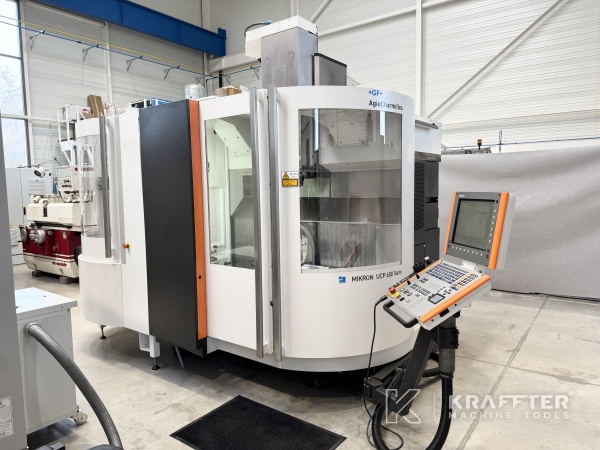
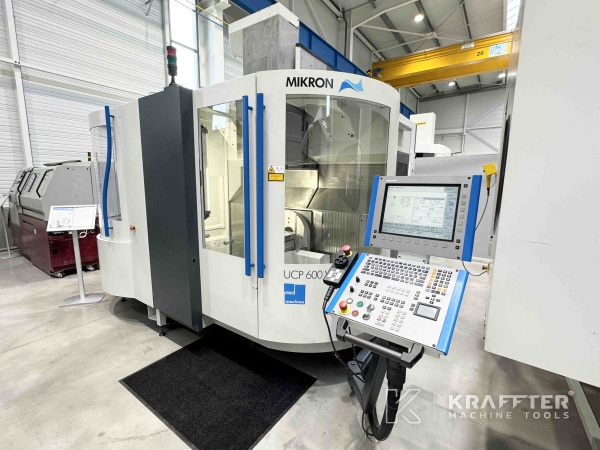
The Mikron UCP 600 Vario is a vertical machining centre with 5 simultaneous axes, designed for complex machining operations in a single part-taking. Developed in the GF AgieCharmilles era (2000s), it illustrates the alliance between high precision and automation. Its ‘UCP’ (Universal Machining Centre) configuration is designed for versatility: it can perform high-speed milling operations on moulds as well as mass-produce multi-sided prismatic parts in a single pass. The name Vario indicates a modular architecture that allows the machine to be adapted (choice of spindles, tool magazines, pallets) according to the customer's needs.
Specific applications:
The UCP 600 Vario is particularly suitable for the continuous machining of 5 faces or 5 axes of complex parts. For example, in aeronautics, it can machine turbine blades or engine components requiring high-precision 3D contours. In general mechanics, it excels in the manufacture of moulds and tools where deep cavities and curved surfaces have to be machined in a single installation. Its pallet changer also makes it a candidate for the automated production of batches of prismatic parts (hydraulic parts, medical implants, high-end watch cases, etc.). The possibility of choosing different spindles (standard, HSM 42k rpm, etc.) makes it versatile for materials ranging from aluminium (HSM machining at 42k) to hardened steel (12k torque spindle).
Advantages and strong points:
This machine offers an optimal compromise between flexibility and performance. Thanks to its direct drive rotary axes, angular positioning is extremely fast and precise, which reduces downtime during multi-face machining. The compact frame of the UCP 600 Vario ensures good rigidity while facilitating accessibility (its design puts the operator close to the table despite the bulk of the axes). Its fast spindle and high axis acceleration guarantee high productivity in 3D milling and HPC (High Performance Cutting). In addition, the integration of automation solutions (palettes, measuring probes, swarf removal, etc.) makes it a complete production cell that can operate 24 hours a day. In short, the Mikron UCP 600 Vario is chosen for its 5-axis precision, its modularity (adaptable Vario configuration) and its suitability for automation in a relatively compact size.
Mikron HSM 800 - machining centre
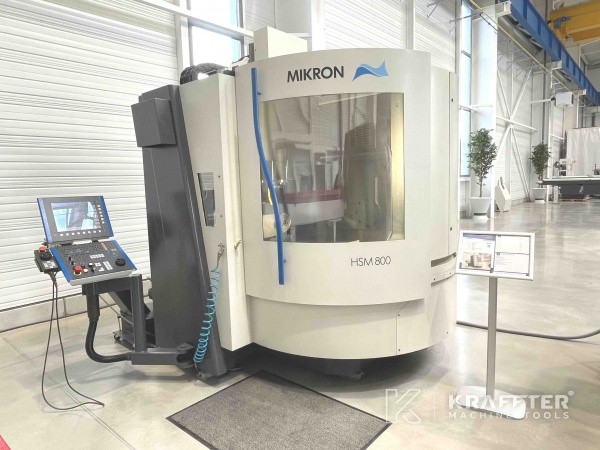
The Mikron HSM 800 is a vertical high-speed machining centre (High Speed Milling) designed for machining parts requiring very fine finishing and rapid execution. Launched in the early 2000s, it was one of the flagship models consolidating Mikron (GF)'s reputation in the field of high-speed milling for moulds and precision. It is a 3-axis machine (a 5-axis HSM 800 U version with a tilting table existed) designed to maintain high dynamic performance even on heavy parts.
Specific applications:
The Mikron HSM 800 is particularly popular in the manufacture of moulds and dies. Its 36k spindle allows it to machine graphite/copper electrodes with great finesse, to produce engravings or micro-structures, and to mill-polish complex surfaces (which reduces the manual polishing of moulds). It is also used for machining high precision parts in aeronautics (e.g. aluminium components for on-board instruments, where surface quality and compliance with 3D geometries are critical). In the medical device industry, the HSM 800 can be used to manufacture orthopaedic implants or implant-manufacturing tools, where excellent surface finish and dimensional accuracy are required. In addition, its ability to handle heavy parts while maintaining precision makes it a popular solution for machining tool bases or mould cavity plates in hardened steel.
Advantages and strong points:
The strength of the HSM 800 lies in its speed of execution and the quality of the finish obtained. With extremely high cutting speeds, it drastically reduces finishing cycle times, and can even allow direct machining without the use of electro-erosion for certain complex moulds. The rigidity of its structure and its ability to handle heavy loads ensure that no concessions are made between the precision and the size of the part. Users also emphasise the exceptional surface quality obtained (thanks to the stable spindle and the fast small passes), often ready for use without retouching. Finally, the HSM 800 shines through its reliability: it is a machine designed to run at high speed permanently, with sophisticated cooling and monitoring systems that prevent drifts. Its ergonomics (easy access to the table, workshop-oriented programming) and GF/Mikron support have convinced many mould-making workshops to invest in this solution to save time while improving precision.
Mikron 102.04 - gear cutting machine
The Mikron 102.04 is a traditional machine for cutting small gears, emblematic of Mikron's historical expertise in watchmaking and micromechanics. Introduced in the mid-20th century, this semi-automatic machine (with exchangeable cams and gears) has been used in many workshops for the production of gear wheels for watches, meters and mechanical devices. Compact and robust, the Mikron 102.04 is based on the principle of hobbing: a helical cylindrical cutter (hobbing cutter) generates the profile of the teeth in synchronised rotation with the workpiece.
Specific applications:
The Mikron 102.04 was widely used in the watchmaking industry for the manufacture of gear trains (barrel pinions, timer wheels, etc.). Its cutting precision was sufficient to obtain the quality required in watchmaking, with a correct surface finish on the tooth. It was also found in the production workshops of mechanical counters, instrument mechanisms (scales, tachometers) or small gearboxes for aerospace and defence (e.g. sighting mechanisms). Although old, this machine is still relevant for very small series or prototyping of precision gears, where investment in a modern CNC would not be justified. Some craftsmen still use it to restore heritage pieces (old watches, automatons) by making gears ‘the old-fashioned way’.
Advantages and strengths:
The main advantage of the Mikron 102.04 is its simplicity and reliability. Once set up, it produces precise gear teeth in a repeatable manner, without the need for electronics. Its cast iron construction gives it great stability and an excellent lifespan – many of them are still working decades after their manufacture, a testament to the quality of Mikron. The machine is relatively versatile in its field: with the right accessories, it can machine a variety of gears (straight, helical, worm) in a range of dimensions that are quite extensive for micromechanics. Finally, it offers an unbeatable return on investment: its maintenance costs are minimal and its productivity, for small parts, remains high due to a simple automatic cycle (the cutter cutting the part from end to end without intervention). For a workshop that has mastered the settings, the Mikron 102.04 remains a small, robust and precise gear cutter, reflecting a time when precision mechanics dominated.
Mikron 102.05 MPS - gear cutting machine
The Mikron 102.05 MPS represents the modernised evolution of the previous model, incorporating improvements for series production and precision. The MPS suffix stands for Multi Programme System, indicating the presence of a more advanced cycle controller, or even partial digitisation of the movements. Released towards the end of the 1970s, this version features automation that reduces operator intervention and improves the regularity of gear cutting. Externally, the 102.05 looks very similar to the 102.04, except for the addition of electrical control elements.
Specific applications:
Like the 102.04, this machine is designed for the manufacture of small precision gears. The 102.05 MPS was widely used in modern watch factories at the end of the 20th century, when production intensified and required more automation. It was also used in production lines for odometers and car dashboard indicators (until the 1990s, many of these meters were mechanical). In the medical field, it was used by companies to make tiny gears for pumps or surgical instruments. Its precision and repeatability made it suitable for gears requiring little adjustment after machining. Moreover, for technical education or the production of gear prototypes, the 102.05 offers a compromise between the purely manual machine and the expensive CNC - it could be used in tooling workshops to create specific pinions during developments.
Advantages and strengths:
The Mikron 102.05 MPS offers greater productivity than its predecessor thanks to cycle control: the operator can launch a gear cutting programme and attend to other tasks during execution, whereas the 102.04 would require more supervision. Gear cutting quality is improved by the possibility of multiple controlled passes, guaranteeing better finishing and precision of tooth profiles. It of course benefits from the same mechanical advantages as the 102.04 (stability, longevity), while reducing the risk of human error (the cycle parameters being recorded in the MPS). For a company, this machine represented a step towards automation without sacrificing the initial investment: it was a relatively economical solution to increase watch production volumes in the 1980s. Even today, there are reconditioned Mikron 102.05 MPS machines operating in specialised workshops, proof that these machines retain technical relevance and economic appeal for certain precision gear niche markets.