













Our used machine tool brands
okuma machine tool: traditional craftsmanship of excellence and technological innovations
Okuma Corporation has been one of the world leaders in high-precision machine tools for over 120 years. It has an extensive range of over 100 products, including CNC lathes, machining centres, multi-tasking machines, CNC grinders and peripheral equipment. Thanks to its expertise in mechatronics, Okuma is one of the few CNC machine manufacturers to master the entire industrial process, from machine manufacturing to numerical control. This ability to control every aspect of production ensures that its innovations are perfectly integrated into state-of-the-art machines, combining performance, reliability and durability. Okuma machine tools thus meet the needs of the most demanding industries with solutions ranging from the machining of small screw threads to large aerospace parts.

Okuma history
Founded in 1898 by Eiichi Okuma under the name of Okuma Noodle Machine Co., the company started out manufacturing pasta processing machines. However, its commitment to excellence was evident from the outset, when its founder, dissatisfied with existing lathes, decided to design more precise ones. It thus quickly evolved to become a major player in the machine tool sector (production of which began in 1904).
By 1937, it had already established itself as the leading machine tool manufacturer in Japan in terms of turnover.
1963 marked an important turning point in Okuma's history with the development of its own numerical control (OSP), equipped with absolute position encoders. This made Okuma the only complete supplier of machines and numerical controls in Japan.
In doing so, from 1976 to 1988, Okuma expanded internationally, opening offices and setting up production subsidiaries in Europe and the United States. Since then, the company has continually expanded its network and production capacity worldwide, with factories in Asia, Europe, America and Australia. In 1991, Okuma officially became Okuma Corporation, a change of status that confirmed its leading role in the machine tool industry.
Okuma's positioning
Okuma stands out from its global competitors thanks to a unique combination of traditional know-how and innovative technologies.
While many machine tool manufacturers tend to focus solely on machine production, Okuma manufactures the machine, drives, motors, encoders, spindle and CNC controller in total autonomy. Even today, the machines and controls are manufactured by Okuma, enabling it to guarantee perfect integration of its products and incomparable reliability.
In addition to its technical know-how, Okuma is also recognised for its rigorous craftsmanship. At each stage of the manufacturing process, master craftsmen pass on their skills and attention to detail, enabling each machine to meet the strictest precision requirements.
Contributions to turning and cylindrical jig grinding
Okuma has made significant contributions to the evolution of turning and cylindrical jig grinding technologies. One of its most significant developments in this field was the non-round slide bearing grinding spindle, developed in 1954 by Shinkichi Nagaoka. This innovative bearing, using a triangular oil film, achieved exceptional rotational accuracy and rigidity, advancing cylindrical grinder technology.
Okuma's GPB cylindrical grinder was a revolutionary breakthrough, thanks to the integration of this technology. This system made it possible to carry out roughing, finishing and sizing processes in a single cycle, thus guaranteeing a high-quality mirror finish. This innovation served as the basis for the rise of the machine tool industry in Japan after the Second World War, and in particular that of CNC.
OSP (Okuma Sampling Path) numerical control is the exclusive CNC system developed by Okuma. When it was created in 1963, it was the first control system with an absolute position encoder, eliminating the need to return to the zero point after the machine was stopped.
Okuma has continued to develop it ever since, with the integration of CNC from 1970 onwards. The introduction in 2004 of the THINC-OSP open platform allows the integration of third-party software and improves interoperability with other industrial systems. The intuitive and connected user interface OSP suite followed in 2014, facilitating the automation and analysis of production data. Finally, today, the introduction of OSP-P500, an optimised version using artificial intelligence, maximises machine productivity and reliability.
Thanks to its OSP control, Okuma offers a unique solution guaranteeing perfect synergy between the machine and its control system, thus optimising the productivity and durability of the equipment.
Today, Okuma continues to push the boundaries of jig grinding and turning technology through its range of CNC products and multitasking machines integrating industrial IoT systems to promote Industry 4.0. Okuma is also preparing for Industry 5.0 with artificial intelligence that analyses machining conditions in real time to optimise processes and reduce tool wear.
Specific technologies
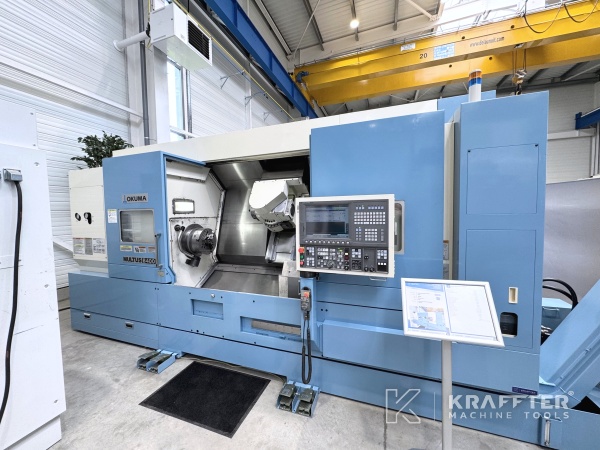
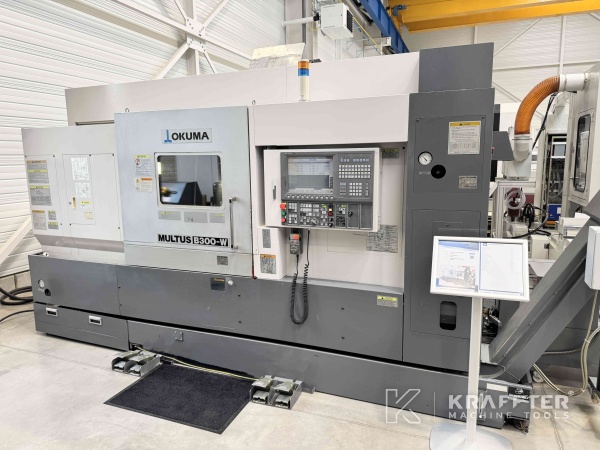
The turning-milling centre, the OKUMA Multus B300-W, is a perfect example of Okuma's ability to combine turning and milling functions in a single piece of equipment. This flexible production centre is designed to handle large, complex parts, enabling ultra-precise machining. With its OSP CNC control, it offers increased productivity and superior precision. The Multus B300-W thus enables manufacturers to optimise their manufacturing processes, reducing costs and improving production times.
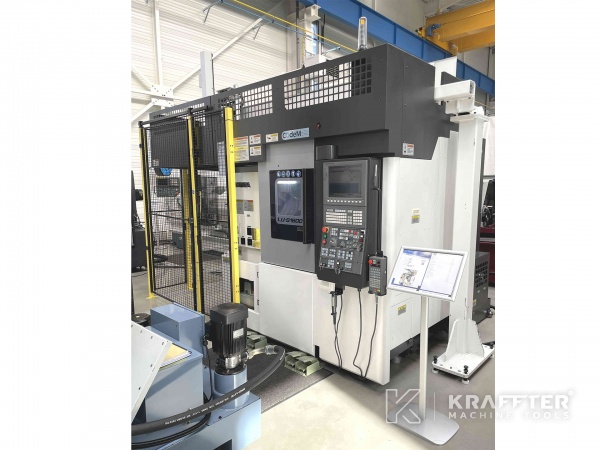
The CNC lathe LU-S1600 is a versatile CNC lathe, particularly suitable for high-precision turning applications in industries such as automotive, aerospace and heavy equipment. It is equipped with Okuma OSP technology, offering advanced numerical control for efficient, high-quality machining. The LU-S1600 is designed to process a wide range of materials with exceptional precision.
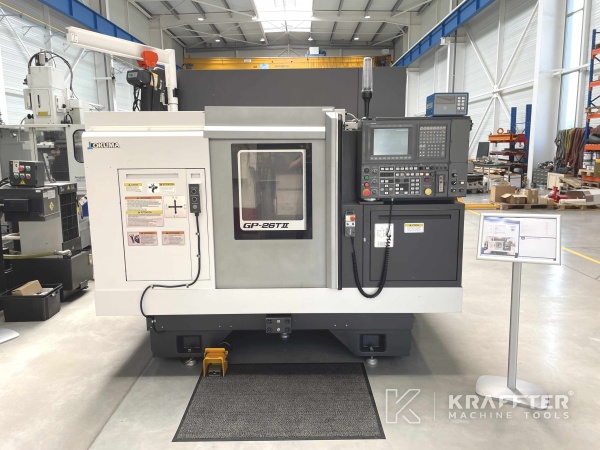
The OKUMA GP-26T II CNC cylindrical grinder is a high-performance CNC cylindrical grinder designed to offer exceptional surface and form accuracy. It is equipped with Okuma CNC technology, guaranteeing maximum stability and long-term precision. This grinder is ideal for jig grinding applications of complex parts requiring fine finishing and sub-micron accuracy.
A commitment to the future
Under the slogan ‘OPEN POSSIBILITIES’, Okuma continues to transform the manufacturing landscape by emphasising its ability to offer solutions tailored to the specific needs of each customer, from small businesses to industrial giants.
One of the keys to this success lies in the exceptional craftsmanship that is passed on within the company, whether in the manufacture of machining centres, turning/milling machines, grinders, or in the development of its CNC controls. By incorporating innovations such as hydrodynamic bearings for grinding wheel spindles, Okuma machines are built to last, because in the absence of contact between the grinding wheel and the metal, their original performance is maintained on a semi-permanent basis. This is a valuable asset in the second-hand market, where Okuma products are highly sought after.
Buying a second-hand Okuma machine tool
The second-hand market for Okuma machines is a strategic opportunity for companies looking for solutions that are both reliable and high-performance, while optimising their investments. Okuma is renowned for its exceptional expertise in the manufacture of reliable, durable and precise machine tools. Their longevity is a major asset for buyers of used machine tools, as they retain their performance and quality characteristics for many years.
The secret of this longevity lies in Okuma's commitment to providing high-quality machines, built with first-class materials and extreme attention to detail, using rigorously controlled and precision-assembled components.
For example, Okuma grinders, such as the GP-26T II, are particularly renowned for their ability to offer an impeccable surface finish and superior dimensional accuracy throughout their life cycle. This reliability ensures that, even after several years of service, these machines continue to meet high quality standards, making them extremely attractive on the second-hand market. In addition, Okuma machines benefit from an excellent support network and a large user base, making it easy for owners to find spare parts and maintenance services.
By investing in robust and technologically advanced machines, companies benefit from significant added value. OKUMA machine tools, whether CNC lathes, machining centres or grinders, offer an excellent opportunity for those who wish to invest in high-quality equipment.